
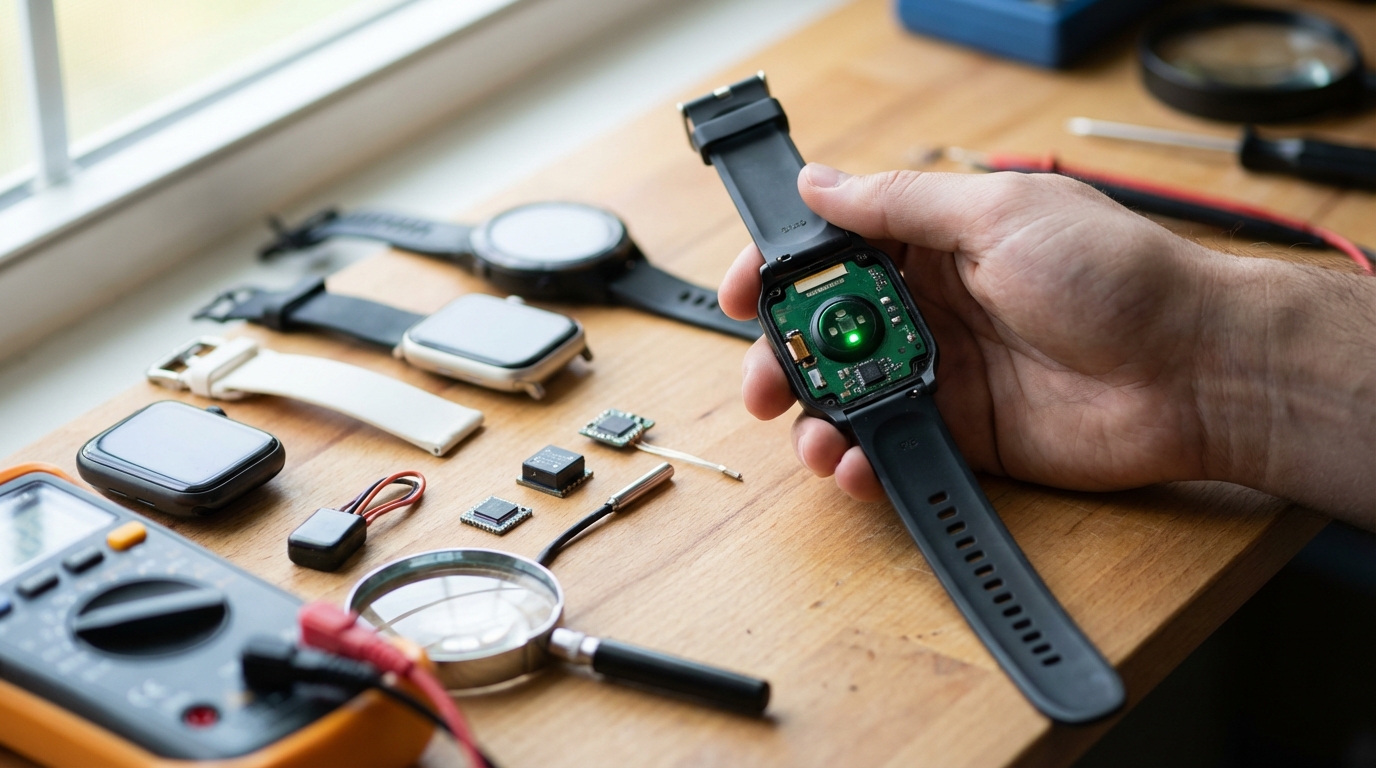
Understanding Sensors Used in Wearable Devices
Wearable technology has transitioned from niche gadgets to an integral part of daily life, encompassing everything from fitness trackers and smartwatches to specialized medical monitors. These compact devices offer a window into our health, activity levels, and surroundings, largely thanks to an intricate array of miniature sensors. These sensors are the fundamental components that collect raw data, acting as the ‘eyes and ears’ of the wearable, enabling it to perceive and quantify various aspects of the user’s physiology and environment. This post will delve into the diverse world of sensors commonly found in wearable devices. We will explore their underlying principles, the types of data they capture, and how this data is transformed into actionable insights that enhance our understanding and management of personal well-being.The Foundation of Wearables: Sensor Categories
At their core, wearable devices are sophisticated data collection platforms. Sensors are purpose-built transducers that convert physical phenomena (like movement, light, or electrical signals) into measurable electrical signals. These signals are then processed and interpreted by the device’s internal systems. The capabilities of any wearable device are directly determined by the types and quality of sensors it incorporates. Generally, sensors in wearables can be categorized by their primary function: motion tracking, physiological monitoring, and environmental interaction.Motion and Positional Tracking Sensors
These sensors are fundamental for understanding user activity, orientation, and movement patterns. They provide the basis for features like step counting, sleep analysis, and gesture recognition.Accelerometers
* **What it measures:** Linear acceleration along one, two, or three axes. They can detect changes in velocity, vibration, and the tilt of the device relative to gravity. * **How it works:** Many modern accelerometers use Micro-Electro-Mechanical Systems (MEMS) technology. A small seismic mass is suspended by springs, and its displacement due to acceleration is measured, often capacitively. * **Applications:** * Step counting and activity level tracking. * Fall detection and impact monitoring. * Orientation sensing and screen rotation. * Sleep phase detection based on movement patterns.Gyroscopes
* **What it measures:** Angular velocity, or the rate of rotation around an axis. This provides information about the device’s rotational movement. * **How it works:** Similar to accelerometers, gyroscopes often employ MEMS technology, utilizing the Coriolis effect on vibrating structures. When the device rotates, these structures experience a force perpendicular to the direction of motion, which is then measured. * **Applications:** * Precise orientation tracking in 3D space. * Gesture recognition. * Enhanced motion analysis when combined with accelerometers (forming an Inertial Measurement Unit, or IMU). * Virtual and augmented reality applications within head-mounted wearables.Magnetometers
* **What it measures:** The strength and direction of magnetic fields, including the Earth’s magnetic field. * **How it works:** Magnetometers typically operate based on the Hall effect or anisotropic magnetoresistance, where changes in a magnetic field alter voltage or resistance across a sensor element. * **Applications:** * Providing compass functionality for determining true north. * Improving positional accuracy and dead reckoning, especially indoors where GNSS signals are weak. * Detecting nearby magnetic disturbances, which can sometimes be used to infer specific environmental contexts. These three sensors (accelerometer, gyroscope, and magnetometer) frequently work in concert as part of an Inertial Measurement Unit (IMU). Sensor fusion algorithms combine their data to provide a comprehensive and accurate understanding of a device’s motion, orientation, and position in three-dimensional space.Physiological Monitoring Sensors
These sensors focus on gathering data directly from the user’s body, providing insights into various physiological states and functions.Photoplethysmography (PPG) Sensors
* **What it measures:** Changes in blood volume in the microvascular bed of tissue, which correlates with heart rate. Some advanced PPG sensors can also infer blood oxygen saturation (SpO2). * **How it works:** A PPG sensor typically consists of a light source (often green LEDs for heart rate, red/infrared for SpO2) and a photodetector. Light is emitted into the skin and absorbed by blood; the remaining reflected or transmitted light is detected. Pulsations in blood flow cause variations in light absorption, which are picked up by the detector. * **Applications:** * Continuous heart rate monitoring. * Heart rate variability (HRV) analysis, an indicator of autonomic nervous system activity. * Sleep stage tracking (changes in heart rate during different sleep phases). * Blood oxygen saturation (SpO2) estimation, useful for respiratory health monitoring.Electrocardiogram (ECG) Sensors
* **What it measures:** The electrical activity of the heart, representing the cardiac cycle. * **How it works:** ECG sensors typically use two or more electrodes that make contact with the skin. These electrodes detect the tiny electrical voltage changes that occur as the heart muscle depolarizes and repolarizes with each beat. * **Applications:** * More accurate and detailed assessment of heart rhythm compared to PPG. * Detection of certain heart rhythm irregularities. * Providing data that can be used for advanced cardiac health assessments.Galvanic Skin Response (GSR) Sensors / Electrodermal Activity (EDA)
* **What it measures:** Changes in the electrical conductivity of the skin, which is influenced by sweat gland activity. This is an indicator of sympathetic nervous system arousal. * **How it works:** A small, imperceptible electrical current is passed between two electrodes on the skin. The resistance to this current changes with the level of moisture (sweat) on the skin’s surface. * **Applications:** * Stress level detection and monitoring. * Emotional arousal assessment. * Sleep phase monitoring (certain sleep stages are associated with specific EDA patterns).Temperature Sensors
* **What it measures:** Skin temperature or, in some cases, ambient temperature. * **How it works:** Thermistors, thermocouples, or infrared sensors are commonly used. Thermistors change their electrical resistance with temperature, while thermocouples generate a voltage proportional to temperature differences. Infrared sensors measure thermal radiation. * **Applications:** * Basal body temperature tracking for fertility awareness. * Fever detection or monitoring changes in body temperature. * Assessing skin temperature fluctuations during sleep cycles. * Environmental temperature monitoring.Environmental Interaction and Location Sensors
These sensors allow wearables to interact with and understand their surrounding environment, providing context and aiding in navigation.Barometric Pressure Sensors
* **What it measures:** Atmospheric pressure. * **How it works:** Often MEMS-based, these sensors contain a deformable diaphragm that changes electrical properties (e.g., capacitance) as external pressure fluctuates. * **Applications:** * Altitude tracking (pressure decreases with altitude). * Estimating elevation gain, such as during stair climbing or hiking. * Basic weather forecasting (detecting changes in atmospheric pressure).Global Navigation Satellite System (GNSS) Receivers (e.g., GPS)
* **What it measures:** Precise geographical position (latitude, longitude, altitude) and speed. * **How it works:** GNSS receivers detect and process radio signals transmitted from a constellation of Earth-orbiting satellites. By triangulating signals from multiple satellites, the receiver can calculate its exact position. * **Applications:** * Outdoor activity tracking (running, cycling routes). * Navigation and location services. * Accurate distance and pace measurement for exercise.Ambient Light Sensors
* **What it measures:** The intensity of light in the device’s immediate environment. * **How it works:** Photodiodes or phototransistors convert light energy into an electrical current or voltage. The stronger the light, the greater the electrical output. * **Applications:** * Automatic display brightness adjustment to save battery and improve visibility. * Assessing light exposure patterns, which can influence circadian rhythms and sleep.The Role of Data Processing and Algorithms
While sensors are crucial for data collection, their raw output is rarely immediately useful. The intelligence of a wearable device lies in its ability to process this raw data through sophisticated algorithms and often machine learning models. This involves: * **Sensor Fusion:** Combining data from multiple sensors (e.g., accelerometer and gyroscope) to provide a more accurate and robust understanding of movement or context than a single sensor could offer. * **Signal Processing:** Filtering out noise, correcting for artifacts, and extracting relevant features from the sensor signals. * **Pattern Recognition:** Identifying specific patterns in the data that correspond to particular activities, physiological states, or events (e.g., recognizing a walk versus a run, or identifying a sleep stage). Through these computational steps, meaningless electrical signals are transformed into meaningful metrics like step counts, calories burned, heart rate zones, sleep quality scores, or stress level indicators, providing the user with insightful and actionable information.Conclusion
The remarkable capabilities of modern wearable devices are intrinsically linked to the ingenuity and evolution of their embedded sensors. From meticulously tracking every movement to vigilantly monitoring vital physiological signals and understanding the ambient environment, these miniature components are the silent workhorses that power the personalized data revolution. As technology continues to advance, we can anticipate even smaller, more accurate, and increasingly multi-functional sensors, leading to a new generation of wearables that offer even deeper insights into our health, performance, and interaction with the world around us. The continuous innovation in sensor technology will undoubtedly further integrate these devices into our lives, offering unprecedented opportunities for self-awareness and proactive well-being management.Frequently Asked Questions
**Q1: How do multiple sensors work together in a single wearable device?** A1: Multiple sensors often work together through a process called sensor fusion. Algorithms combine data from various sensors (e.g., accelerometers, gyroscopes, magnetometers) to create a more comprehensive and accurate understanding of the user’s movement, context, or physiological state than any single sensor could provide alone. This fusion improves accuracy, reduces errors, and provides richer data. **Q2: Are the measurements from wearable sensors always perfectly accurate?** A2: Wearable sensor measurements provide valuable estimations and indicators, but their accuracy can be influenced by several factors. These include device placement, skin contact, user movement, environmental conditions, and individual physiological variations. While generally reliable for tracking trends and providing insights, they may not always match clinical-grade precision. **Q3: What is the primary limitation of wearable sensors?** A3: A significant limitation lies in the interpretation and contextualization of the raw data they collect. While sensors are excellent at measuring physical phenomena, translating this data into truly meaningful, personalized, and universally applicable insights often requires sophisticated algorithms, extensive data sets, and a deep understanding of human physiology and behavior. Another challenge is balancing comprehensive data collection with power consumption constraints. **Q4: Can wearable sensors detect specific health conditions or illnesses?** A4: Wearable sensors can often detect patterns or deviations in physiological data (like heart rate, activity levels, or skin temperature) that might be indicative of potential health issues or changes. However, they typically provide indicators and not definitive diagnoses. For any suspected health condition, it is crucial to consult with qualified healthcare professionals for accurate diagnosis and treatment. **Q5: What is the fundamental difference between an accelerometer and a gyroscope?** A5: An accelerometer measures linear acceleration, detecting changes in speed or orientation relative to gravity (e.g., sensing steps or tilt). A gyroscope, on the other hand, measures angular velocity, detecting the rate of rotation around an axis (e.g., sensing how quickly a device is twisting or turning). They are often used together to provide a complete picture of motion and orientation.
Diana Miller, is a dedicated nature enthusiast and an outdoor adventurer. She began leading groups for excursions in her teens and never stopped. Following her passion for nature, she gathers her friends for outdoor trips every now and then. And for the last 10 years, she has executed workshops on backpacking, snow kayaking and traveling that included her main motive of lightweight packing while outdoors. During leisure, she loves planning for her next adventure.