
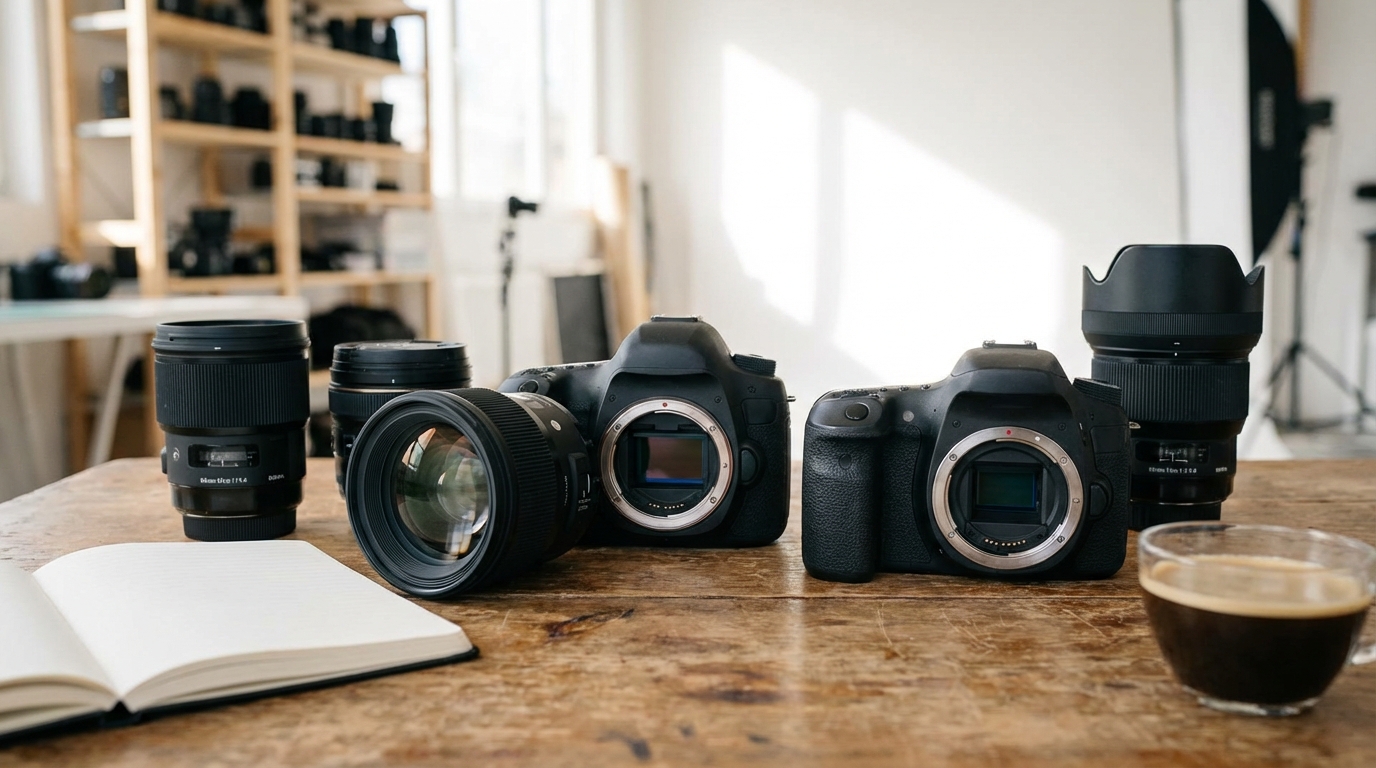
The journey into photography often involves understanding the core components that capture light and transform it into an image. Among these, the camera sensor plays a fundamental role, directly influencing aspects from image quality to depth of field and lens characteristics. Two predominant sensor formats widely discussed are crop sensors and full-frame sensors. While both serve the purpose of digital image capture, they possess distinct attributes that cater to different photographic styles, budgets, and operational needs. This exploration aims to clarify the technical and practical distinctions between these two sensor types, providing a comprehensive understanding for photographers at any level.
Understanding Digital Camera Sensors
At the heart of every digital camera lies its sensor, a sophisticated semiconductor device responsible for converting light into an electrical signal. This signal is then processed to create the digital image file. Sensors are composed of millions of tiny light-sensitive points called photosites, or pixels. When light hits these photosites, they record the intensity and color information. The physical size of the sensor, along with the size and number of its individual photosites, significantly impacts the image characteristics.
- Light Gathering: Larger sensors, with their greater surface area, generally have more and/or larger photosites, enabling them to gather more light. This is crucial for performance in challenging lighting conditions.
- Image Detail and Noise: The amount of light captured per photosite influences the signal-to-noise ratio. More light often translates to a cleaner signal and less digital noise, particularly at higher ISO settings.
- Field of View: The physical dimensions of the sensor also dictate the angle of view captured by a lens of a specific focal length.
Full-Frame Sensors Explained
A full-frame sensor is a digital image sensor that measures approximately 36mm x 24mm, mirroring the dimensions of a single frame of traditional 35mm film. For decades, 35mm film was a widely adopted standard, and full-frame digital sensors were developed to replicate the photographic characteristics associated with this format. They are typically found in advanced enthusiast and professional-grade cameras.
Key Characteristics of Full-Frame Sensors:
- Physical Size: The larger surface area allows for larger individual photosites (pixels) compared to smaller sensors with the same megapixel count, or more photosites for higher resolution.
- Low-Light Performance: Due to their ability to capture more light per photosite, full-frame sensors often exhibit superior performance in low-light environments, producing images with less digital noise at higher ISO settings.
- Dynamic Range: They generally offer a wider dynamic range, meaning they can capture more detail in both the brightest highlights and darkest shadows of a scene simultaneously.
- Depth of Field Control: Full-frame sensors inherently allow for a shallower depth of field at equivalent focal lengths and apertures compared to smaller sensors. This makes it easier to achieve significant background blur (bokeh), helping to isolate subjects effectively.
- Wider Field of View: A lens with a given focal length (e.g., 50mm) will produce a wider angle of view on a full-frame camera than on a crop sensor camera.
Considerations for Full-Frame Systems:
While offering numerous advantages, full-frame cameras and their accompanying lenses often represent a more substantial investment. The camera bodies tend to be larger and heavier, and lenses designed for full-frame coverage are generally bigger, heavier, and more costly to produce.
Crop Sensors Explained
Crop sensors are physically smaller than full-frame sensors. The most common type is the APS-C (Advanced Photo System type-C) sensor, which varies slightly in size depending on the camera manufacturer (e.g., approximately 23.6mm x 15.7mm for some brands, and 22.2mm x 14.8mm for others). Another prevalent crop sensor format is Micro Four Thirds (MFT), which measures 17.3mm x 13mm.
Key Characteristics of Crop Sensors:
- Physical Size: Smaller dimensions mean a more compact sensor, which allows for smaller camera bodies and often more compact lenses.
- Crop Factor: The most significant characteristic of a crop sensor is its “crop factor.” This is a multiplier that describes how much narrower the field of view is compared to a full-frame sensor using the same focal length lens. Common crop factors are 1.5x, 1.6x (for APS-C), and 2.0x (for Micro Four Thirds).
- Effective Focal Length: Due to the crop factor, a lens mounted on a crop sensor camera will have a narrower field of view that is equivalent to a longer focal length lens on a full-frame camera. For example, a 50mm lens on a 1.5x crop sensor camera provides a field of view similar to a 75mm lens on a full-frame camera.
- Greater Depth of Field: All else being equal (focal length, aperture, subject distance), crop sensors will yield a greater depth of field than full-frame sensors. This can be advantageous in scenarios where maximum sharpness across a scene, such as in landscape photography, is desired.
Considerations for Crop Sensor Systems:
Crop sensor cameras are generally more accessible in terms of cost, making them a popular choice for beginners and enthusiasts. The smaller sensor size allows for more compact and lighter camera bodies and lenses, contributing to greater portability. While they may not match full-frame sensors in extreme low-light conditions or dynamic range, modern crop sensors deliver excellent image quality and are highly capable tools for a wide range of photographic pursuits.
Field of View and Focal Length Equivalence
The concept of “crop factor” is central to understanding the practical differences between sensor sizes, particularly concerning lenses and their effective field of view. When a lens is designed for a full-frame sensor, it projects an image circle large enough to cover that sensor’s dimensions. When the same lens is placed on a crop sensor camera, only the central portion of that image circle is used, effectively “cropping” the scene.
- Impact on Wide-Angle Photography: Achieving extremely wide angles of view can be more challenging with crop sensor cameras, as a very wide focal length lens (e.g., 10mm) on a crop sensor might only provide the field of view of a moderately wide lens (e.g., 15mm or 16mm) on a full-frame camera.
- Advantage in Telephoto Photography: Conversely, the crop factor acts as a magnification, extending the “reach” of telephoto lenses. A 300mm lens on a 1.5x crop sensor camera offers a field of view equivalent to a 450mm lens on a full-frame camera. This can be beneficial for wildlife, sports, or other situations requiring distant subjects to appear closer.
It is important to remember that the focal length of a lens remains constant regardless of the sensor it is mounted on; it is the field of view that changes due to the sensor size.
Depth of Field Considerations
Depth of field refers to the range of distance in a photograph that appears acceptably sharp. It is influenced by aperture, focal length, and subject distance. Sensor size also plays a crucial role.
- Shallow Depth of Field: Full-frame sensors, due to their larger physical dimensions, make it easier to achieve a shallow depth of field. This allows photographers to isolate subjects against blurred backgrounds, a technique often utilized in portrait photography to draw attention to the subject.
- Greater Depth of Field: Crop sensors, conversely, naturally produce a greater depth of field. This means more of the scene will be in focus at a given aperture and focal length. This characteristic can be advantageous for genres like landscape photography, where photographers often aim to keep extensive parts of the scene sharp from foreground to background.
While techniques exist to achieve a shallower depth of field on crop sensors (e.g., using wider apertures or longer focal lengths), and conversely, a greater depth of field on full-frame (e.g., stopping down the aperture), the inherent properties of each sensor size offer a starting point for different creative expressions.
Low-Light Performance and Dynamic Range
The ability of a camera to perform well in low-light conditions and to capture a broad spectrum of tones from deep shadows to bright highlights (dynamic range) are significant indicators of sensor capability.
- Low-Light Sensitivity: Generally, full-frame sensors excel in low-light situations. Their larger photosites can gather more photons, leading to a stronger signal and less digital noise when the ISO sensitivity is increased. This allows for cleaner images in dim environments and greater flexibility when shooting handheld in challenging light.
- Dynamic Range: Similarly, full-frame sensors typically offer a broader dynamic range. This means they can record more subtle gradations between the darkest and brightest parts of a scene, reducing the likelihood of blown-out highlights or crushed shadows in high-contrast situations. While modern crop sensors have made substantial advancements in these areas, the physical advantage of a larger sensor often remains discernible.
Lens Compatibility and Selection
The choice between a full-frame or crop sensor camera also impacts lens selection and compatibility.
- Full-Frame Lenses on Crop Sensor Cameras: Lenses designed to cover a full-frame sensor can generally be used on crop sensor cameras from the same manufacturer and mount system. When used this way, only the central, sharper portion of the lens’s image circle is utilized, which can sometimes result in sharper images by avoiding the softer edges of the lens. However, these lenses are often larger, heavier, and more expensive than lenses specifically designed for crop sensors.
- Crop Sensor Lenses on Full-Frame Cameras: Lenses designed specifically for crop sensors project a smaller image circle. If mounted on a full-frame camera, they will likely produce significant vignetting (darkening at the edges) or a circular image in the center of the frame, unless the full-frame camera is switched to a “crop mode,” which then essentially uses only the central part of its sensor, effectively reducing its resolution.
- Lens System Choices: Many manufacturers offer lens lines optimized for each sensor type, denoted by specific abbreviations (e.g., Canon’s EF vs. EF-S, Nikon’s FX vs. DX, Sony’s FE vs. E). Understanding these distinctions is crucial for building an efficient and compatible camera system.
Conclusion
The distinction between crop sensor and full-frame cameras is not about one being definitively superior, but rather about understanding their differing characteristics and how these align with individual photographic needs, preferences, and budgets. Full-frame sensors offer advantages in low-light performance, dynamic range, and the ability to achieve a very shallow depth of field, often at the cost of higher price, weight, and size. Crop sensors, on the other hand, provide excellent value, portability, and the “reach” advantage with telephoto lenses, while still delivering impressive image quality in a broad range of conditions.
Ultimately, the choice hinges on factors such as the primary subjects photographed, the importance of portability, specific creative goals, and financial considerations. Both sensor types are highly capable tools for capturing stunning images, and a thorough understanding of their differences empowers photographers to make informed decisions about their equipment.
Frequently Asked Questions (FAQs)
1. What is sensor size in photography?
Sensor size refers to the physical dimensions of the camera’s image sensor, which captures light to create an image. It is measured in millimeters and significantly impacts image quality, depth of field, field of view, and overall camera system size and cost.
2. Does a full-frame camera always take “better” photos?
Not necessarily. While full-frame cameras generally offer advantages in low-light performance, dynamic range, and depth of field control, modern crop sensor cameras are highly capable. The quality of a photograph depends more on the photographer’s skill, lens quality, and lighting conditions than solely on sensor size.
3. Can I use full-frame lenses on a crop sensor camera?
Yes, typically. Lenses designed for full-frame cameras can usually be mounted on crop sensor cameras from the same manufacturer and lens mount system. However, due to the crop factor, the lens will exhibit a narrower field of view, making it appear as if its focal length has increased.
4. What is the “crop factor”?
The crop factor is a multiplier that describes how much smaller a crop sensor is compared to a full-frame sensor. It indicates the degree to which a crop sensor “crops” the scene compared to a full-frame sensor using the same focal length lens, effectively narrowing the field of view (e.g., 1.5x, 1.6x, 2.0x).
5. Which sensor type is more suitable for landscape photography?
Both sensor types can excel in landscape photography. Full-frame cameras can capture wider angles of view and offer more detail in highlights and shadows. Crop sensor cameras can provide greater depth of field at similar aperture settings, which can be advantageous for keeping an entire landscape in focus, and are generally more portable for hiking.

Diana Miller, is a dedicated nature enthusiast and an outdoor adventurer. She began leading groups for excursions in her teens and never stopped. Following her passion for nature, she gathers her friends for outdoor trips every now and then. And for the last 10 years, she has executed workshops on backpacking, snow kayaking and traveling that included her main motive of lightweight packing while outdoors. During leisure, she loves planning for her next adventure.