
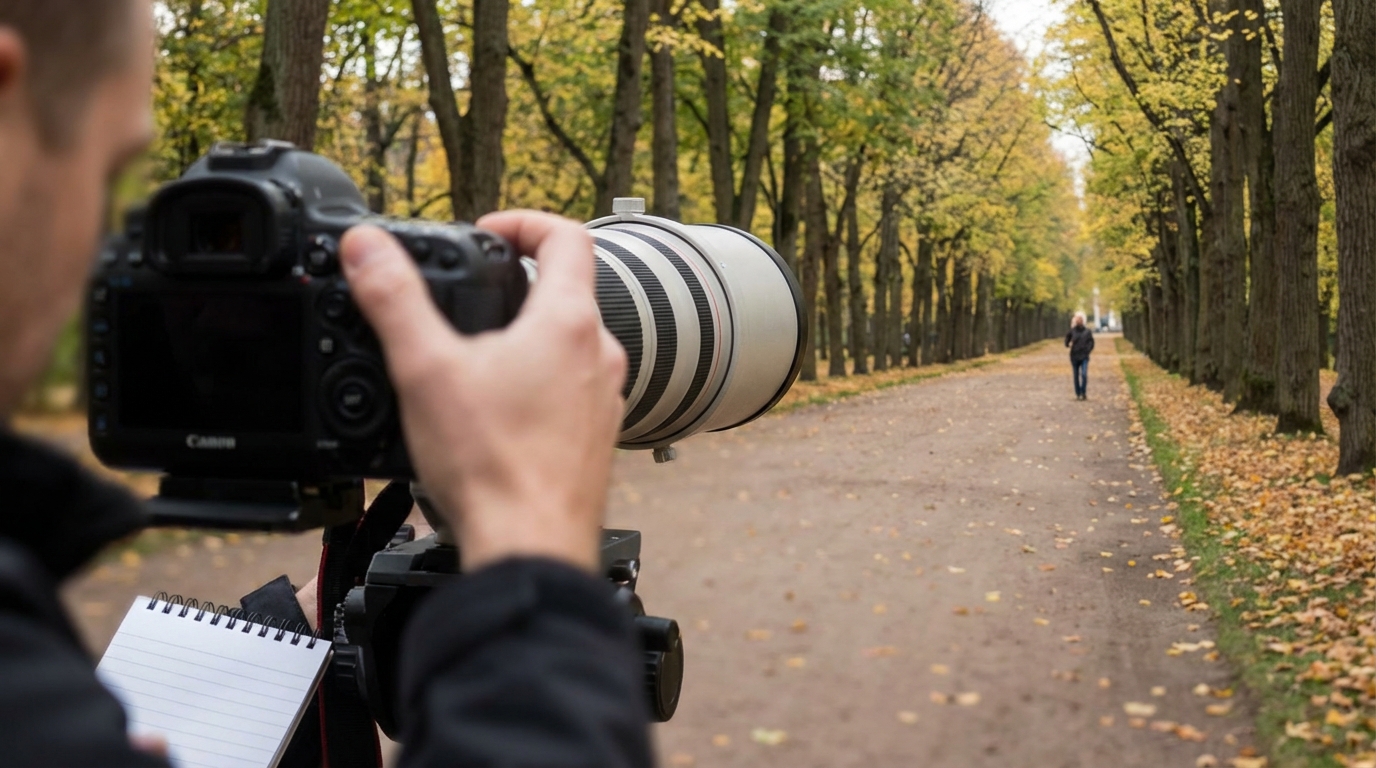
Understanding the Impact of Lens Focal Length on Image Perspective
In the realm of photography, lens focal length is a fundamental concept that significantly influences the final image. While often associated with how “zoomed in” or “zoomed out” a scene appears, its deeper impact lies in how it alters the perceived perspective and spatial relationships within a photograph. This effect is not about the lens physically distorting objects, but rather how it dictates the necessary distance between the camera and the subject to achieve a specific framing, which in turn reshapes the visual narrative. This discussion will delve into the mechanics of focal length, how it interacts with subject distance, and the profound changes it brings to an image’s perspective, enabling photographers to make deliberate creative choices.What is Focal Length?
Focal length is a measurement, typically expressed in millimeters (mm), that represents the distance from the optical center of a lens to the camera’s sensor or film plane when the subject is in sharp focus at infinity. More practically, focal length directly determines two key attributes: * **Angle of View:** How much of the scene the lens can capture. A shorter focal length yields a wider angle of view, while a longer focal length results in a narrower angle. * **Magnification:** How large subjects appear in the frame. Longer focal lengths offer greater magnification, making distant subjects appear closer. Lenses are broadly categorized by their focal length: * **Wide-angle lenses:** Typically below 35mm (on a full-frame sensor). * **Normal lenses:** Around 50mm (on a full-frame sensor). * **Telephoto lenses:** Above 70mm (on a full-frame sensor).Understanding Perspective in Photography
Perspective in photography refers to the apparent spatial relationships between objects within a two-dimensional image. It’s how the size, shape, and position of objects appear relative to each other, to the viewer, and to their distance from the camera. This is heavily influenced by the camera’s position relative to the subject and surrounding elements. It’s not just about what is in the frame, but how those elements interact visually.How Focal Length Influences Angle of View
The relationship between focal length and angle of view is inverse: * **Shorter focal lengths** (e.g., 20mm) capture a much broader scene, offering an expansive angle of view. * **Longer focal lengths** (e.g., 200mm) capture a much smaller, more isolated portion of the scene, resulting in a narrow angle of view. This inherent characteristic of lenses is the starting point for understanding how perspective is affected. To fill the frame with a subject using a wide-angle lens, you must move closer. To fill the frame with the same subject using a telephoto lens, you must move further away. This change in subject distance is the critical factor in altering perspective.The Interplay of Focal Length and Subject Distance
The fundamental principle is this: focal length itself does not directly distort objects or compress space. Instead, it dictates *how close or far* the camera must be from a subject to achieve a particular framing (i.e., making the subject appear a certain size in the frame). It is this necessary change in **subject distance** that fundamentally alters the perceived perspective.Wide-Angle Lenses (Shorter Focal Lengths)
When utilizing wide-angle lenses (e.g., 14mm to 35mm on a full-frame camera), photographers must often move closer to their primary subject to ensure it occupies a significant portion of the frame. This proximity has distinct effects on perspective: * **Exaggerated Depth:** Distances between foreground objects and background elements appear significantly increased. Objects close to the camera seem much larger, while those further away recede dramatically into the distance. * **Dynamic and Immersive Feel:** The expansive view can create a sense of immersion, drawing the viewer into the scene. * **Apparent Distortion:** Objects at the edges of the frame, or those very close to the lens, can appear stretched or distorted. This is because the lens captures a very wide field, and when close, the difference in distance between the nearest and furthest parts of an object (or between different objects) relative to the camera becomes highly pronounced. For example, a person’s nose might appear much larger than their ears if photographed too close with a wide lens. * **Applications:** Ideal for landscapes, architectural interiors, and scenes where emphasizing scale, vastness, or powerful foreground elements is desired.Telephoto Lenses (Longer Focal Lengths)
Conversely, telephoto lenses (e.g., 70mm to 300mm and beyond on a full-frame camera) require the photographer to position themselves further away from the subject to achieve a similar framing. This increased distance results in a different perspective alteration: * **Compressed Depth (Foreshortening):** Distances between objects appear significantly reduced. Foreground and background elements seem “squashed” together, making them appear closer to each other than they are in reality. * **Flattened Perspective:** This creates a more two-dimensional, less dynamic visual quality. Subjects appear almost layered against their backgrounds. * **Isolation and Magnification:** The narrow angle of view and magnification isolate the subject from its surroundings, making it stand out. * **Applications:** Excellent for portraiture (providing a flattering perspective with minimal facial distortion), wildlife, sports, and bringing distant elements of a landscape into prominence.Normal Lenses (Mid-Range Focal Lengths)
Normal lenses (typically around 50mm on a full-frame camera) strike a balance. Their angle of view closely approximates that of human natural vision, and they allow for a shooting distance that often feels intuitive and natural. * **Balanced Perspective:** Objects maintain proportions and spatial relationships that align closely with human perception. They neither significantly exaggerate nor compress depth. * **Natural Look:** These lenses are often favored for documentary, street photography, and situations where a realistic and unbiased portrayal of a scene is desired.Depth of Field and Focal Length
While aperture and subject distance are primary controls for depth of field, focal length also plays a role in its *apparent* effect, contributing to the overall perspective. * **Longer focal lengths** tend to produce a shallower apparent depth of field when the subject is framed to the same size, due to the increased magnification of the background blur. This separation of subject from background enhances the compressed look. * **Wide-angle lenses** tend to produce a deeper apparent depth of field when the subject is framed to the same size, with more of the scene appearing in focus, complementing their expansive perspective.Practical Implications for Composition
Understanding how focal length influences perspective is a powerful tool for creative expression: * **Storytelling:** Choose a wide lens to immerse the viewer in a scene and emphasize context, or a telephoto lens to isolate a subject and focus on its emotion or detail. * **Architectural Photography:** Wide lenses can capture the grandeur of a building but require careful consideration of converging lines and distortion. Telephoto lenses can isolate architectural details without distortion, creating abstract compositions. * **Portraiture:** Longer focal lengths (e.g., 85mm, 105mm, 135mm) are often preferred for portraits because they allow the photographer to maintain a comfortable distance from the subject, resulting in a more flattering, natural perspective that minimizes facial exaggeration. * **Landscape Photography:** Wide lenses are traditional for sweeping vistas, emphasizing foreground elements and expansive skies. Telephoto lenses can compress distant mountain ranges, making them appear more imposing, or isolate interesting patterns. * **Event and Street Photography:** A normal lens offers a natural field of view, blending in with the scene. Wide lenses can capture more of the environment and interactions, while telephotos can capture candid moments from a discreet distance.Conclusion
The relationship between lens focal length and image perspective is one of the most fundamental and creatively impactful concepts in photography. It is not that a lens inherently distorts objects, but rather that its focal length dictates the required camera-to-subject distance to achieve a specific framing. This change in shooting distance is what profoundly alters the apparent spatial relationships within an image, either exaggerating distances with wide-angle lenses or compressing them with telephoto lenses. By understanding this dynamic interplay, photographers gain the ability to make deliberate choices that shape the narrative, emotional impact, and visual integrity of their images. It empowers them to move beyond simply capturing a scene and instead, to truly manipulate perception and craft compelling visual stories.Frequently Asked Questions (FAQs)
-
Does a lens physically distort objects?
No, a lens itself doesn’t physically distort objects. The apparent distortion or stretching/compression of perspective is a consequence of the required camera-to-subject distance associated with a particular focal length to achieve a similar subject size in the frame. When you move very close with a wide-angle lens, the parts of the subject nearer to the camera become disproportionately larger compared to parts further away, creating the “distortion” effect. -
Is “lens compression” a real phenomenon?
The term “lens compression” is commonly used to describe the effect seen with telephoto lenses where background elements appear closer to the subject and to each other. However, it’s not the lens *compressing* reality. Instead, it’s a result of the photographer standing further away from the subject. This increased distance means the relative difference in distance between the subject and the background, from the camera’s viewpoint, becomes less significant, leading to the visual “compression.” -
Why do portraits taken with wide-angle lenses sometimes look unflattering?
Portraits taken with wide-angle lenses often look unflattering because the photographer has to move very close to the subject to fill the frame. When shooting up close, the parts of the face nearest to the camera (like the nose) appear disproportionately larger, while other features (like ears) recede, leading to an exaggerated, sometimes distorted, appearance. Longer focal length lenses allow the photographer to stand further back, resulting in a more natural and pleasing perspective. -
Can I change perspective without changing my lens?
Yes, you can change perspective without changing your lens, but only by changing your camera’s physical position relative to your subject. Moving closer or further away will alter the spatial relationships between elements in your frame, even if you keep the same focal length. However, to achieve the dramatic exaggerations or compressions commonly associated with wide-angle or telephoto lenses, a significant change in focal length (and consequently, subject distance) is typically necessary. -
What does a “normal” focal length mean?
A “normal” focal length refers to a lens that produces an angle of view and a perspective that closely approximates human vision. For a full-frame sensor camera, this is typically around 50mm. On crop-sensor cameras, a slightly shorter focal length would be considered “normal” due to the crop factor (e.g., 35mm on an APS-C sensor, which has a full-frame equivalent field of view of about 50mm). These lenses offer a balanced perspective, neither exaggerating nor compressing distances significantly.

Diana Miller, is a dedicated nature enthusiast and an outdoor adventurer. She began leading groups for excursions in her teens and never stopped. Following her passion for nature, she gathers her friends for outdoor trips every now and then. And for the last 10 years, she has executed workshops on backpacking, snow kayaking and traveling that included her main motive of lightweight packing while outdoors. During leisure, she loves planning for her next adventure.