
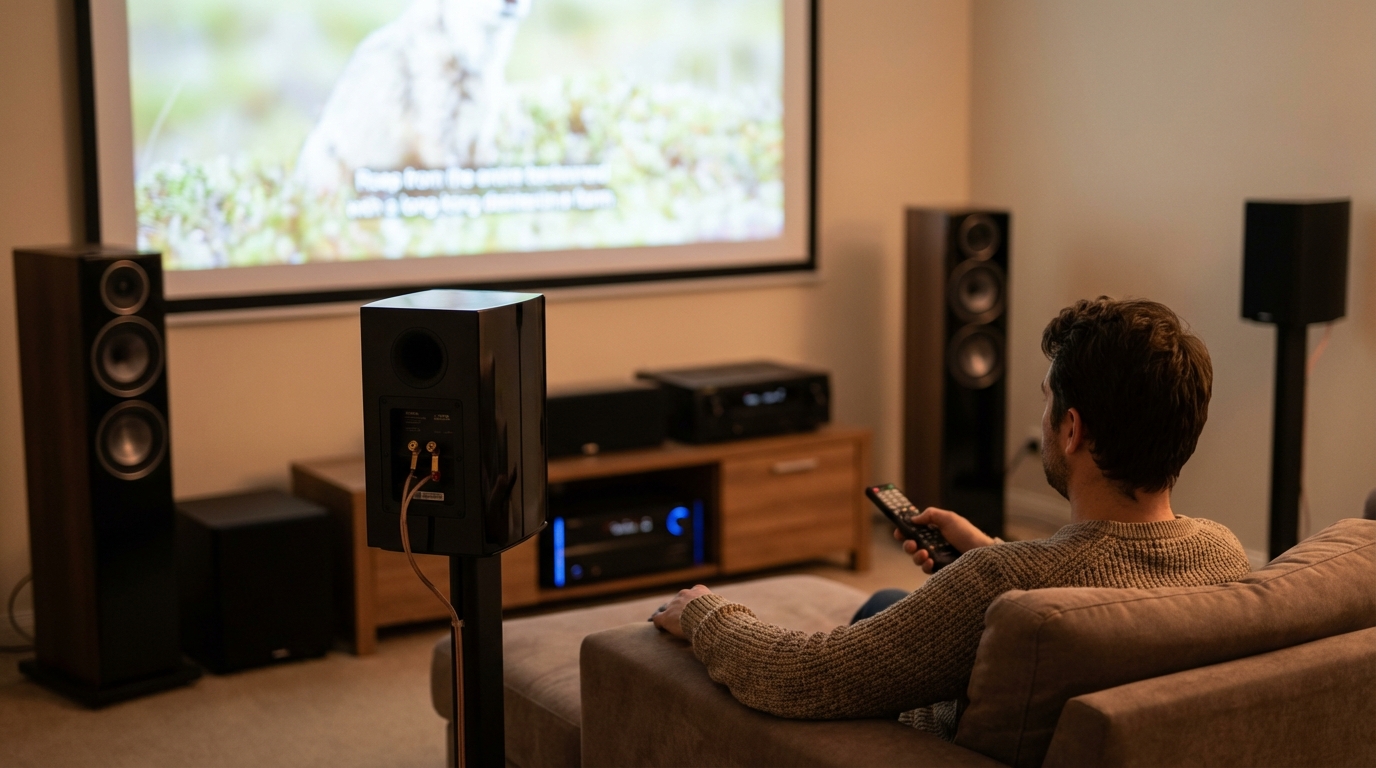
The Architecture of Immersive Soundscapes: How Surround Sound Systems Create Engaging Audio
The experience of cinema, gaming, and even music can be profoundly transformed when sound transcends its traditional two-dimensional boundaries. Surround sound systems are engineered precisely for this purpose: to envelop listeners in a rich, multi-directional audio environment that mirrors the real world. By intelligently distributing distinct audio signals around a space, these systems create a compelling sense of presence, placing sounds not just in front of the listener, but beside, behind, and even above them. This intricate orchestration of sound elements is achieved through a combination of sophisticated audio encoding, specialized hardware, and careful acoustic calibration.Understanding Human Audio Perception
Before delving into the technical aspects of surround sound, it is helpful to understand how humans naturally perceive the direction and depth of sound. Our auditory system is remarkably adept at localizing sound sources, primarily relying on several cues: * **Inter-aural Time Difference (ITD):** The slight difference in the time it takes for a sound to reach each ear. A sound originating from the left will arrive at the left ear microseconds before the right. * **Inter-aural Level Difference (ILD):** The difference in sound intensity (loudness) at each ear. The head acts as a barrier, slightly “shadowing” the ear farther from the sound source, causing the sound to be softer. * **Pinna Effects:** The unique shape of our outer ear (pinna) subtly modifies incoming sound waves based on their angle of arrival. The brain interprets these subtle spectral changes to determine elevation and front-back distinctions. * **Reverberation and Echoes:** The way sound reflects off surfaces in an environment also provides cues about the size and nature of a space, adding to the perceived depth and realism of an audio scene. By understanding these natural mechanisms, audio engineers can design surround sound systems that effectively trick the brain into perceiving a vast, three-dimensional soundscape from electronically reproduced audio.The Evolution from Stereo to Multi-Channel Audio
The journey to immersive audio began with monophonic sound, where all audio information was delivered through a single channel. This evolved into stereo audio, which introduced two distinct channels—left and right—allowing for rudimentary directional cues and a wider “soundstage.” While a significant improvement, stereo sound still largely confines audio to a plane in front of the listener, limiting the sense of being truly “within” the audio environment. The fundamental shift to surround sound involved the addition of more discrete audio channels, each assigned to a specific speaker position around the listener. This expanded the soundstage from a frontal arc to a full circle, and eventually, a sphere. By delivering separate audio streams to these additional speakers, a sound engineer can place individual sound effects, dialogue, and ambient noise at precise points in the room, mirroring how sounds occur in a real-world setting. This multi-channel approach significantly enhances realism and immersion, making the listener feel like an active participant rather than a passive observer.Key Components of a Surround Sound System
A complete surround sound system comprises several interconnected components, each playing a critical role in delivering the immersive experience: *Audio Source
The foundation of any surround sound experience is content encoded for multi-channel playback. This typically includes movie soundtracks on streaming services or physical media, video games, and specialized music recordings that carry discrete audio information for multiple channels. *AV Receiver or Processor
Often considered the “brain” of the system, the AV receiver performs several crucial functions: * **Decoding:** It receives the multi-channel audio signal from the source and decodes it into its individual speaker channels. * **Amplification:** It provides power to drive each of the connected speakers. * **Switching:** It manages multiple audio and video inputs, allowing the user to switch between different sources. * **Processing:** Many receivers also include advanced audio processing capabilities, such as room correction and equalization. *Speakers
The speakers are the transducers that convert electrical signals back into audible sound waves. In a typical surround sound setup, there are several distinct types of speakers, each with a specific role: * **Center Channel Speaker:** Placed directly above or below the display, this speaker primarily handles dialogue, ensuring that voices appear to come directly from the on-screen action. * **Front Left and Right Speakers:** These speakers establish the main stereo soundstage and handle a significant portion of the music, effects, and directional cues originating from the front. * **Surround Left and Right Speakers:** Positioned to the sides or slightly behind the listening area, these speakers are crucial for ambient sounds, environmental effects, and sounds that are intended to pass by or engulf the listener. * **Subwoofer:** This speaker is dedicated to reproducing low-frequency effects (LFE), such as explosions, rumbling, and deep bass notes. It adds significant impact and realism to action sequences and music. * **Height or Elevation Speakers:** In more advanced systems, these speakers are mounted on the ceiling, placed high on walls, or designed to reflect sound off the ceiling. They introduce a vertical dimension to the soundscape, allowing for sounds to appear to come from above. *Cabling and Connectivity
Proper cabling is essential for transmitting the audio signals from the receiver to the speakers without degradation. High-quality speaker wire, HDMI cables for digital audio and video transmission, and optical or coaxial cables for older digital audio formats ensure clean signal delivery.Decoding Technologies and Channel Configurations
Surround sound relies on sophisticated encoding and decoding technologies to deliver multi-channel audio. Early systems utilized matrix encoding, where surround information was embedded within two stereo channels and then extracted by a decoder. Modern systems, however, predominantly use discrete multi-channel encoding, where each channel’s audio information is stored and transmitted independently. Common channel configurations are typically represented by a series of numbers, such as 5.1 or 7.1. The first number indicates the number of main, full-range channels (front left/right, center, surround left/right, etc.), while the “.1” denotes the presence of a dedicated low-frequency effects (LFE) channel for the subwoofer. * **5.1 Surround Sound:** This configuration includes five full-range channels (front left, center, front right, surround left, surround right) and one LFE channel. It is a widely adopted standard for home theater, offering a significant upgrade in immersion over stereo. * **7.1 Surround Sound:** Building upon 5.1, this configuration adds two additional surround channels, typically placed directly behind the listening position (back surround left and back surround right). This enhances the sense of rearward sound movement and envelopment. More recently, advanced object-based audio technologies have emerged. Unlike traditional channel-based systems, where sounds are “mixed” into specific speaker channels, object-based audio treats individual sounds (e.g., a helicopter, a drop of rain, a gunshot) as independent “objects” with metadata describing their position in a 3D space. The playback system then intelligently renders these objects through the available speakers, including height channels, to accurately reproduce their intended position and movement. This dynamic rendering allows for a highly precise and adaptive 3D sound experience, making sounds appear to come from virtually any point around and above the listener, irrespective of the exact speaker layout.The Role of Speaker Placement and Calibration
Achieving truly immersive surround sound is not solely about having the right equipment; precise speaker placement and meticulous system calibration are equally critical. *Speaker Placement
General guidelines suggest that front left and right speakers should form an equilateral triangle with the main listening position. The center channel should be aligned with the screen. Surround speakers are typically placed to the sides or slightly behind the listener, ideally above ear level. For systems incorporating height channels, these are strategically placed on the ceiling or high on walls to create the vertical sound dimension. The subwoofer’s placement is often more flexible but can benefit from experimentation to find the position that yields the smoothest bass response in the room. *System Calibration
Once speakers are in place, the system needs to be calibrated. This involves adjusting several parameters to ensure balanced and accurate sound reproduction: * **Speaker Levels:** Each speaker’s volume is adjusted so that they all produce sound at the same perceived loudness at the main listening position. * **Speaker Distances/Delays:** Since speakers are rarely equidistant from the listener, the receiver introduces slight delays to the closer speakers, ensuring that sound from all channels arrives at the listener’s ears simultaneously. This maintains accurate localization and phase coherence. * **Equalization (EQ):** Room acoustics can significantly impact sound quality. Calibration systems often use a microphone to measure the room’s frequency response and then apply equalization to compensate for peaks and dips, resulting in a flatter, more neutral sound. Many modern AV receivers include automated calibration systems that simplify this process, using a supplied microphone to measure the room acoustics and automatically set the appropriate parameters. However, manual fine-tuning can often further refine the sound to personal preference.How Immersion is Achieved
The combined effect of discrete multi-channel audio, advanced decoding, and proper setup allows surround sound systems to create unparalleled immersion through several mechanisms: * **Directionality:** Sounds are no longer vague. A car driving from left to right, a bullet whizzing past, or footsteps approaching from behind are reproduced with convincing directional accuracy, placing the listener within the scene. * **Spaciousness and Ambiance:** Surround channels excel at reproducing ambient sounds like rainfall, crowd chatter, or the rustle of leaves, giving the listener a strong sense of being in a particular environment. * **Detail and Clarity:** By distributing various elements of the soundtrack across multiple speakers, each sound can be rendered with greater clarity and distinctness, preventing sounds from merging into an indistinct wash. * **Low-Frequency Impact:** The dedicated subwoofer provides deep, tactile bass that is felt as much as it is heard, adding a visceral layer of realism to impacts, explosions, and musical scores. * **Three-Dimensional Soundscapes:** With height channels and object-based audio, sounds can literally appear to come from above, such as an airplane flying overhead or rain falling on a roof. This vertical dimension completes the spherical soundstage, creating a truly encompassing and lifelike audio experience.Conclusion
Surround sound systems are a testament to the intricate relationship between technology and human perception. By meticulously controlling the spatial distribution and timing of audio signals, these systems transcend the limitations of conventional stereo, transforming passive listening into an active, immersive engagement. From the foundational principles of how we hear to the sophisticated architecture of multi-channel decoding and precise speaker calibration, every aspect works in concert to construct compelling sonic environments. The result is an audio experience that not only enhances entertainment but also deepens the connection between the audience and the content, making them feel truly present within the unfolding story or virtual world. —Frequently Asked Questions (FAQs)
**Q1: What is the core difference between stereo and surround sound?** A1: Stereo sound typically uses two channels (left and right) to create a frontal soundstage. Surround sound, in contrast, utilizes multiple discrete channels (e.g., 5.1, 7.1, or more) distributed around the listener, including channels to the sides, rear, and sometimes above, to create a more immersive, three-dimensional audio environment. **Q2: Is a subwoofer essential for surround sound?** A2: While a system can function without a subwoofer, it is highly recommended and considered a critical component for a complete surround sound experience. The subwoofer is dedicated to reproducing low-frequency effects (LFE), such as deep bass, explosions, and rumbles, adding significant impact and realism that most smaller full-range speakers cannot achieve. **Q3: What does the “point one” (.1) signify in 5.1 or 7.1 systems?** A3: The “.1” in configurations like 5.1 or 7.1 refers to the dedicated low-frequency effects (LFE) channel. This channel is specifically designed to send deep bass sounds to the subwoofer, enhancing the overall impact and tactile feel of the audio. **Q4: Can I use any speakers for a surround sound setup?** A4: While technically you can connect various speakers, using speakers that are acoustically matched (from the same manufacturer or series) for the front three channels (left, center, right) is generally advisable. This helps maintain a consistent tonal quality as sounds pan across the front soundstage. For surround and height channels, the requirements can be slightly less stringent, but good quality speakers are always beneficial. **Q5: How important is speaker placement in a surround sound system?** A5: Speaker placement is extremely important. Incorrect placement can diminish the effectiveness of the system, leading to poor sound imaging, incorrect sound localization, and an overall less immersive experience. Proper placement, often guided by established standards and followed by calibration, ensures that sounds appear to come from their intended locations and that the audio is balanced throughout the listening area.
Diana Miller, is a dedicated nature enthusiast and an outdoor adventurer. She began leading groups for excursions in her teens and never stopped. Following her passion for nature, she gathers her friends for outdoor trips every now and then. And for the last 10 years, she has executed workshops on backpacking, snow kayaking and traveling that included her main motive of lightweight packing while outdoors. During leisure, she loves planning for her next adventure.