
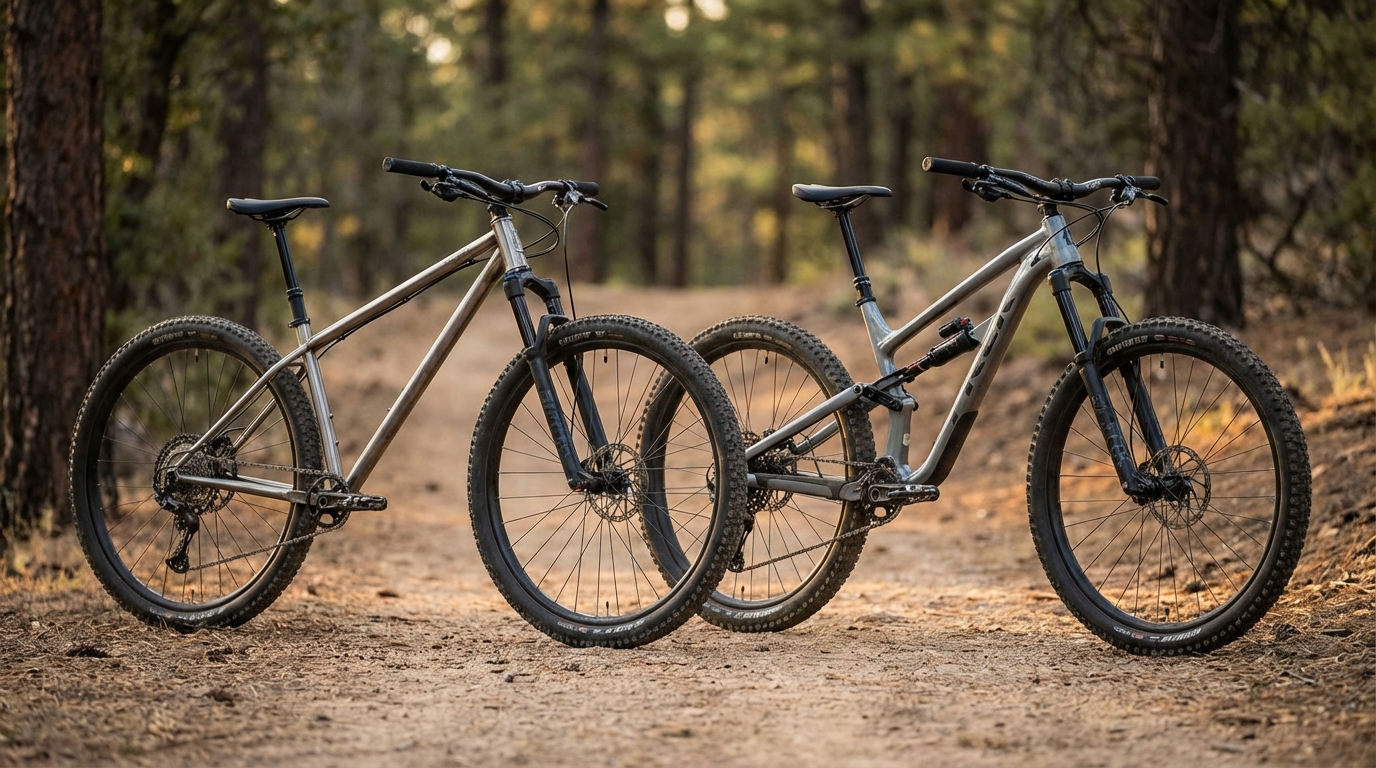
Understanding the Fundamental Differences Between Hardtail and Full Suspension Bicycles
Navigating the world of off-road cycling reveals a spectrum of bicycle designs, each tailored to specific riding experiences and terrains. Among the most foundational distinctions in mountain biking is the presence or absence of rear suspension. This design choice fundamentally shapes a bicycle’s characteristics, influencing everything from its handling and comfort to its maintenance requirements and suitability for various trails. This discussion will explore the core differences between hardtail and full suspension bicycles, elucidating their respective designs, operational principles, and implications for riders.The Role of Suspension in Cycling
Bicycle suspension systems are engineered to absorb impacts and vibrations encountered during riding. Their primary functions include: * **Enhancing Comfort:** Reducing the harshness of impacts transmitted from the ground to the rider. * **Improving Traction:** Keeping the tires in contact with the ground for longer periods, especially over rough terrain, which improves grip for both climbing and braking. * **Increasing Control:** Allowing the rider to maintain a more stable and predictable path over obstacles. * **Reducing Rider Fatigue:** Minimizing the physical effort required to absorb shocks with the body. While all mountain bikes feature front suspension, the presence of rear suspension is the defining characteristic that differentiates a hardtail from a full suspension model.Hardtail Bicycles: Simplicity and Efficiency
A hardtail bicycle is characterized by a frame that incorporates front suspension but lacks any rear suspension mechanism. The rear triangle of the frame is rigid, creating a direct connection between the rear wheel and the rider.Design Principle of Hardtails
The term “hardtail” literally refers to the “hard” or rigid rear “tail” of the bike. This design means that any impacts or vibrations encountered by the rear wheel are transmitted directly through the frame to the rider. The front wheel, however, benefits from a suspension fork that compresses to absorb shocks from obstacles.Key Components of Hardtails
* **Front Suspension Fork:** This is the primary shock-absorbing component, typically an air or coil-sprung fork with varying amounts of travel (the distance the fork can compress). * **Rigid Rear Triangle:** The rear wheel is bolted directly to the frame without any pivots or shock absorbers.Riding Characteristics and Applications of Hardtails
Hardtails offer a distinct set of advantages and disadvantages that shape their riding feel and suitability for specific environments. * **Direct Power Transfer:** The rigid rear triangle ensures that virtually all pedaling effort is transferred directly to the rear wheel. This makes hardtails highly efficient for climbing, accelerating, and riding on smoother terrain where energy loss to suspension bob is not a factor. * **Lighter Weight:** Generally, hardtail frames are lighter than full suspension frames due to the absence of a rear shock, pivots, and linkage systems. This contributes to better climbing efficiency and overall agility. * **Simpler Maintenance:** With fewer moving parts, hardtails typically require less maintenance. There are no rear shock seals, bushings, or pivot bearings to service, which can translate to lower long-term costs and less downtime. * **Cost-Effectiveness:** Due to their simpler construction, hardtails often come at a lower initial purchase price compared to full suspension bicycles with similar component specifications. * **Terrain Suitability:** Hardtails excel on smoother trails, fire roads, gravel paths, and less technical cross-country (XC) routes. They are also frequently used for urban commuting, pump tracks, and dirt jumping. * **Rider Skill Development:** Riding a hardtail on rougher terrain often demands greater rider input and skill. Riders learn to use their body to absorb impacts, choose lines carefully, and adapt to the trail, which can foster improved technical riding abilities.Full Suspension Bicycles: Comfort and Control
Full suspension bicycles incorporate both front and rear suspension systems, allowing both wheels to move independently to absorb impacts. This design significantly alters how the bike interacts with the terrain and how the rider experiences the ride.Design Principle of Full Suspension Bikes
A full suspension frame features a complex design with multiple pivot points and a rear shock absorber. When the rear wheel encounters an obstacle, the rear triangle of the frame pivots, compressing the rear shock and absorbing the impact. This allows the rear wheel to maintain contact with the ground over uneven surfaces.Key Components of Full Suspension Bikes
* **Front Suspension Fork:** Similar to hardtails, but often with more travel and advanced damping features to handle more aggressive terrain. * **Rear Shock Absorber:** Typically an air or coil spring unit that absorbs impacts from the rear wheel. * **Linkage System and Pivots:** A series of links and bearings that connect the main frame triangle to the rear swingarm, dictating the rear wheel’s path of travel and how the suspension compresses.Riding Characteristics and Applications of Full Suspension Bikes
Full suspension bicycles are engineered to provide enhanced comfort, control, and traction, particularly in challenging environments. * **Enhanced Comfort:** By absorbing impacts from both wheels, full suspension bikes significantly reduce the vibrations and shocks transmitted to the rider. This leads to a smoother, more comfortable ride, especially over long distances or rough terrain. * **Improved Traction and Control:** The ability of the rear wheel to move independently helps it maintain consistent contact with the ground. This improves traction for climbing over roots and rocks, and enhances control during technical descents and braking, as the tires are less likely to skip or lose grip. * **Increased Stability and Speed:** On technical, rocky, or root-laden descents, full suspension bikes offer superior stability and allow riders to maintain higher speeds with greater confidence due to their ability to smooth out the trail. * **Reduced Rider Fatigue:** The bike’s suspension system absorbs many of the forces that a rider would otherwise have to absorb with their legs and arms. This translates to less physical fatigue, enabling riders to ride longer and with greater intensity. * **More Complex Maintenance:** The presence of a rear shock, pivots, and linkage systems means more components that require regular inspection and servicing. Seals, bearings, and shock internals need attention to maintain optimal performance, potentially leading to higher maintenance costs and greater complexity. * **Higher Weight:** Generally, full suspension frames are heavier than hardtail frames due to the additional components, structural reinforcement around pivots, and the rear shock itself. * **Higher Initial Cost:** The advanced engineering, additional components, and manufacturing complexity of full suspension bikes typically result in a higher purchase price. * **Terrain Suitability:** Full suspension bikes are highly suitable for a wide range of technical mountain biking disciplines, including aggressive trail riding, enduro, downhill, and technical cross-country. They excel on trails with significant roots, rocks, drops, and jumps.Key Differentiating Factors Summarized
To provide a concise overview, here are the fundamental differences between hardtail and full suspension bicycles: * **Suspension Configuration:** * **Hardtail:** Front suspension only; rigid rear. * **Full Suspension:** Both front and rear suspension. * **Power Transfer and Efficiency:** * **Hardtail:** Direct and highly efficient, especially on climbs and smooth terrain. * **Full Suspension:** Some energy loss due to suspension movement (pedal bob), though modern designs minimize this. * **Comfort and Traction:** * **Hardtail:** Less comfortable on rough terrain; traction can be compromised on uneven surfaces. * **Full Suspension:** Significantly more comfortable; superior traction and control over obstacles. * **Maintenance Requirements:** * **Hardtail:** Simpler and less frequent maintenance. * **Full Suspension:** More involved and frequent maintenance due to additional moving parts. * **Weight Considerations:** * **Hardtail:** Generally lighter. * **Full Suspension:** Generally heavier. * **Cost Implications:** * **Hardtail:** Typically lower initial purchase price. * **Full Suspension:** Typically higher initial purchase price. * **Terrain Suitability:** * **Hardtail:** Ideal for smoother trails, XC, pump tracks, urban riding. * **Full Suspension:** Ideal for technical trails, downhill, enduro, aggressive trail riding.Conclusion
The decision between a hardtail and a full suspension bicycle ultimately hinges on a rider’s individual preferences, the type of terrain they intend to ride most frequently, their budget, and their willingness to engage in maintenance. Hardtails offer a raw, efficient, and direct riding experience, excelling on less technical trails and fostering precise riding skills. Full suspension bicycles provide a more forgiving, comfortable, and controlled ride, allowing for higher speeds and greater confidence on challenging, technical terrain. Both designs serve distinct purposes within the broad spectrum of cycling, offering unique advantages that cater to different riding styles and aspirations.Frequently Asked Questions (FAQs)
**Q1: Which type of bike is generally faster?** A1: The speed of a bike depends heavily on the terrain. On smooth trails or climbs, a hardtail’s direct power transfer can make it faster. On rough, technical descents or highly uneven terrain, a full suspension bike’s ability to maintain traction and absorb impacts typically allows for significantly higher speeds and more control. **Q2: Are hardtail bikes only suitable for beginner riders?** A2: No, hardtails are not exclusively for beginners. While they can be a great starting point, many experienced and highly skilled riders prefer hardtails for their efficiency, direct feel, and the challenge they present on technical trails. They are also prevalent in disciplines like cross-country racing, dirt jumping, and bikepacking. **Q3: Is a full suspension bike always more comfortable than a hardtail?** A3: Generally, yes, a full suspension bike provides a more comfortable ride, especially on rough and technical trails. The rear suspension absorbs impacts that a hardtail would transmit directly to the rider, significantly reducing body fatigue and jarring sensations. On very smooth terrain, the comfort difference might be less pronounced, but it is still often noticeable. **Q4: How much more maintenance does a full suspension bike typically require?** A4: Full suspension bikes generally require more maintenance due to their additional moving parts. This includes regular checks of pivot bearings for play, servicing of the rear shock (similar to a front fork, requiring seal and oil changes), and ensuring all suspension linkages are clean and free of grit. Hardtails primarily require maintenance for their front fork and standard drivetrain/brake components. **Q5: Can a hardtail be ridden on aggressive downhill trails or large jumps?** A5: While a hardtail can be ridden on various trails, including some aggressive ones, it requires significantly more rider skill, strength, and precise line choice to handle large jumps or very steep, technical downhill sections compared to a full suspension bike. The lack of rear suspension means the rider’s body must absorb all rear wheel impacts, making it more physically demanding and potentially less forgiving for errors.
Diana Miller, is a dedicated nature enthusiast and an outdoor adventurer. She began leading groups for excursions in her teens and never stopped. Following her passion for nature, she gathers her friends for outdoor trips every now and then. And for the last 10 years, she has executed workshops on backpacking, snow kayaking and traveling that included her main motive of lightweight packing while outdoors. During leisure, she loves planning for her next adventure.