
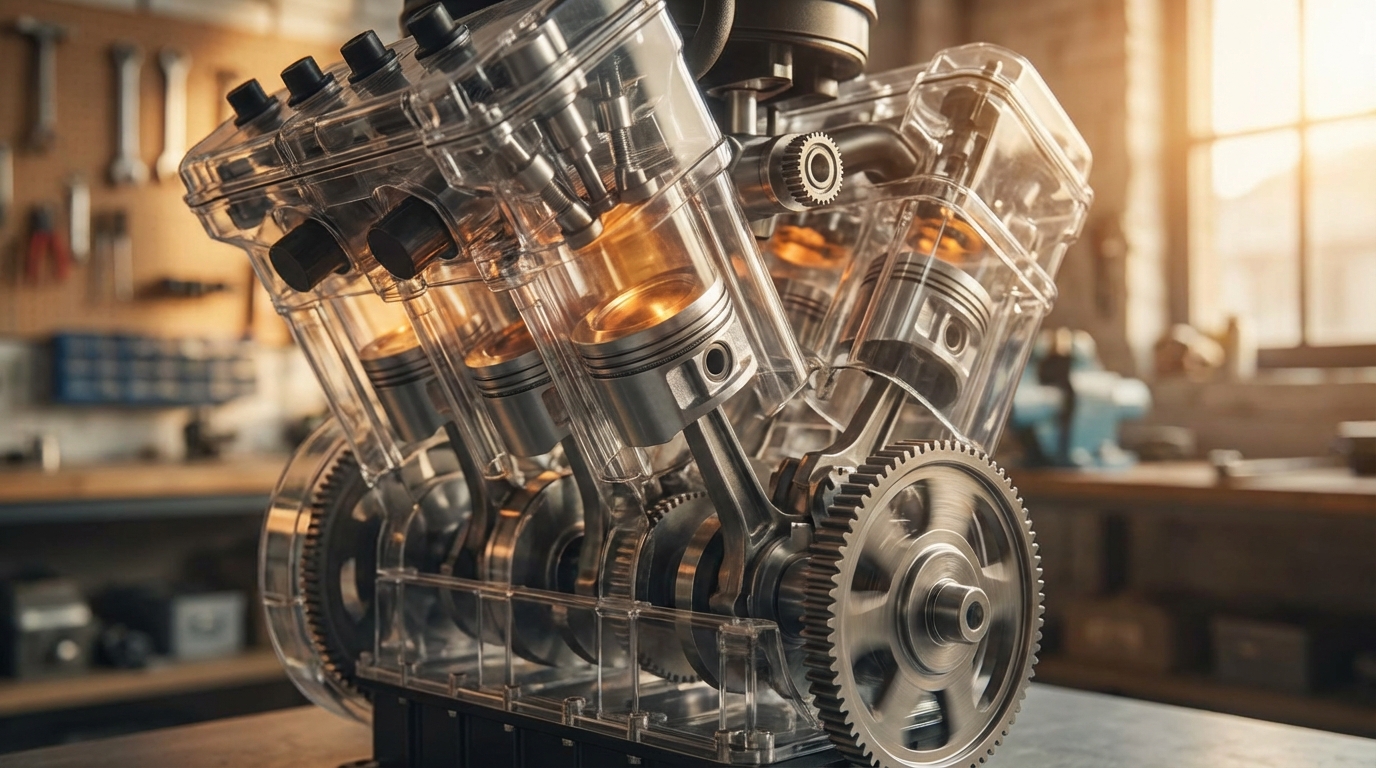
Engines are fundamental to modern life, powering everything from automobiles and aircraft to generators and industrial machinery. At their core, these devices perform an incredible transformation: converting the chemical energy stored in fuel into mechanical energy that can perform work. This intricate process involves a precise sequence of events, harnessing the power of controlled combustion to create movement.
Understanding how engines achieve this conversion sheds light on the ingenuity of their design and the physical principles at play. While various engine types exist, the underlying principle often involves similar stages of intake, compression, combustion (or power), and exhaust, meticulously orchestrated to generate continuous motion.
The Fundamental Principle: Combustion
The journey from fuel to motion begins with combustion, a rapid chemical reaction that releases energy in the form of heat and expanding gases. In the context of an engine, this is a highly controlled process designed to occur within a confined space.
The Elements of Combustion
- Fuel: The source of chemical energy, typically gasoline, diesel, or natural gas.
- Oxidizer: Oxygen from the air, which reacts with the fuel.
- Ignition Source: A means to initiate the reaction, such as a spark plug in gasoline engines or the intense heat generated by compression in diesel engines.
When these elements combine under the right conditions, the fuel rapidly oxidizes, producing hot, high-pressure gases. It is this sudden expansion of gases that provides the force necessary to drive the engine’s mechanical components.
Key Components of a Reciprocating Internal Combustion Engine
The most common type of engine that converts fuel into mechanical energy is the reciprocating internal combustion engine. Its design relies on several interconnected components working in harmony:
- Cylinder: A cylindrical chamber where combustion takes place. Engines often have multiple cylinders.
- Piston: A movable disc that fits snugly within the cylinder. The expanding gases from combustion push the piston downwards.
- Connecting Rod: A rigid link that connects the piston to the crankshaft, translating the piston’s linear (up-and-down) motion into rotational motion.
- Crankshaft: A shaft with offset journals (cranks) that converts the reciprocating motion of the pistons into continuous rotational motion, which can then be used to power a vehicle or machine.
- Valves: Precisely timed intake and exhaust valves that open and close to allow the fuel-air mixture into the cylinder and expel the exhaust gases.
- Spark Plug (Gasoline Engines): An electrical device that creates a spark to ignite the compressed fuel-air mixture.
- Fuel Injector (Diesel Engines): A device that sprays finely atomized fuel directly into the highly compressed, hot air within the cylinder.
The Four-Stroke Cycle (Otto Cycle)
Many gasoline engines operate on a four-stroke cycle, also known as the Otto cycle, named after Nikolaus Otto. Each cycle involves four distinct piston movements, or “strokes,” over two complete revolutions of the crankshaft:
1. Intake Stroke
- The piston moves downwards, increasing the volume inside the cylinder.
- The intake valve opens, allowing a precisely measured mixture of fuel and air to be drawn into the cylinder from the intake manifold.
- The exhaust valve remains closed.
2. Compression Stroke
- Both the intake and exhaust valves close, sealing the cylinder.
- The piston moves upwards, compressing the fuel-air mixture into a much smaller volume.
- This compression significantly increases the pressure and temperature of the mixture, preparing it for ignition.
3. Power (Combustion) Stroke
- As the piston reaches the top of its compression stroke, the spark plug emits an electrical spark.
- This spark ignites the compressed fuel-air mixture, causing rapid combustion.
- The combustion process generates a sudden surge of high-pressure, hot gases that push the piston forcefully downwards. This downward motion is the source of the engine’s mechanical energy.
4. Exhaust Stroke
- As the piston reaches the bottom of its power stroke and begins to move upwards again, the exhaust valve opens.
- The upward movement of the piston pushes the spent combustion gases (exhaust) out of the cylinder and into the exhaust manifold.
- The intake valve remains closed.
Once the exhaust stroke is complete, the exhaust valve closes, and the intake valve opens again to begin a new cycle. This continuous sequence of four strokes generates constant rotational motion from the crankshaft.
Variations: Diesel Engines (Compression-Ignition)
Diesel engines operate on a similar four-stroke principle but differ significantly in how the combustion is initiated. Instead of a spark plug, diesel engines rely on compression ignition:
- Intake Stroke: Only air is drawn into the cylinder.
- Compression Stroke: The air is compressed to a much higher degree than in a gasoline engine. This extreme compression raises the temperature of the air significantly, often exceeding 540°C (1000°F).
- Power Stroke: As the piston approaches the top of its compression stroke, fuel is directly injected into the superheated air. The high temperature of the air causes the fuel to spontaneously ignite (auto-ignite) without the need for a spark plug. The resulting combustion drives the piston downwards.
- Exhaust Stroke: Similar to gasoline engines, the exhaust gases are expelled.
This method of ignition makes diesel engines generally more thermally efficient and capable of producing higher torque.
Other Engine Architectures
While the four-stroke reciprocating engine is prevalent, other designs also convert fuel into mechanical energy:
Two-Stroke Engines
- These engines complete a power cycle in just two piston strokes (one crankshaft revolution).
- They combine the intake/compression phases and power/exhaust phases, often using ports in the cylinder wall instead of complex valve mechanisms.
- They are simpler, lighter, and produce power more frequently per revolution, making them suitable for applications like chainsaws and some motorcycles.
Rotary Engines (Wankel Engine)
- Instead of reciprocating pistons, a rotary engine uses a triangular rotor that moves eccentrically within an oval-shaped housing.
- This motion creates changing volumes that perform the intake, compression, combustion, and exhaust functions in different chambers around the rotor.
- Rotary engines are known for their smooth operation and high power-to-weight ratio, though they can present unique engineering challenges.
Energy Transfer and Efficiency
The conversion of chemical energy into mechanical energy is not 100% efficient. A significant portion of the energy released during combustion is lost as heat through the exhaust gases and cooling systems, and some is lost due to friction within moving parts. Thermal efficiency refers to the ratio of the mechanical work output to the chemical energy input from the fuel.
Engine designers constantly strive to improve this efficiency through advancements in materials, combustion chamber design, fuel injection systems, and engine management electronics. The goal is to maximize the amount of energy converted into usable mechanical work, which is ultimately transferred via the drivetrain to the wheels, propellers, or other mechanical outputs.
Conclusion
The intricate dance of components within an engine, orchestrating the precise timing of fuel delivery, air intake, compression, ignition, and exhaust, is a remarkable feat of engineering. From the explosive power of combustion to the smooth rotation of a crankshaft, the transformation of chemical energy into mechanical motion is a testament to applied physics and relentless innovation. Whether powering our daily commute or enabling industrial operations, the internal combustion engine remains a vital technology, continuously refined to convert fuel’s potential into the kinetic energy that drives progress.
Frequently Asked Questions
Q1: What is the primary purpose of an engine?
The primary purpose of an engine is to convert stored chemical energy (typically in a fuel) into mechanical energy, which can then be used to perform work, such as moving a vehicle or operating machinery.
Q2: What are the main differences between gasoline and diesel engines?
The main difference lies in the ignition method. Gasoline engines use a spark plug to ignite a compressed fuel-air mixture (spark-ignition). Diesel engines compress only air to a very high degree, causing its temperature to rise significantly, and then inject fuel which spontaneously ignites due to the high temperature (compression-ignition).
Q3: Why are there different engine cycles (e.g., two-stroke vs. four-stroke)?
Different engine cycles are designed for specific applications and performance characteristics. Four-stroke engines are generally more fuel-efficient and produce less emissions, making them suitable for vehicles. Two-stroke engines are simpler, lighter, and offer a higher power-to-weight ratio, making them suitable for smaller, more portable equipment or certain high-performance applications where emissions are less of a concern.
Q4: What happens to the energy that isn’t converted into mechanical motion?
A significant portion of the energy from fuel combustion is not converted into useful mechanical work. This energy is primarily lost as heat through the engine’s exhaust gases and cooling system, and also as heat generated by friction between moving parts within the engine.
Q5: Can engines run on any type of fuel?
No, engines are specifically designed to run on particular types of fuel. Gasoline engines require gasoline, and diesel engines require diesel fuel, each with different chemical properties and ignition requirements. Using the wrong type of fuel can severely damage or prevent the engine from operating.

Diana Miller, is a dedicated nature enthusiast and an outdoor adventurer. She began leading groups for excursions in her teens and never stopped. Following her passion for nature, she gathers her friends for outdoor trips every now and then. And for the last 10 years, she has executed workshops on backpacking, snow kayaking and traveling that included her main motive of lightweight packing while outdoors. During leisure, she loves planning for her next adventure.