
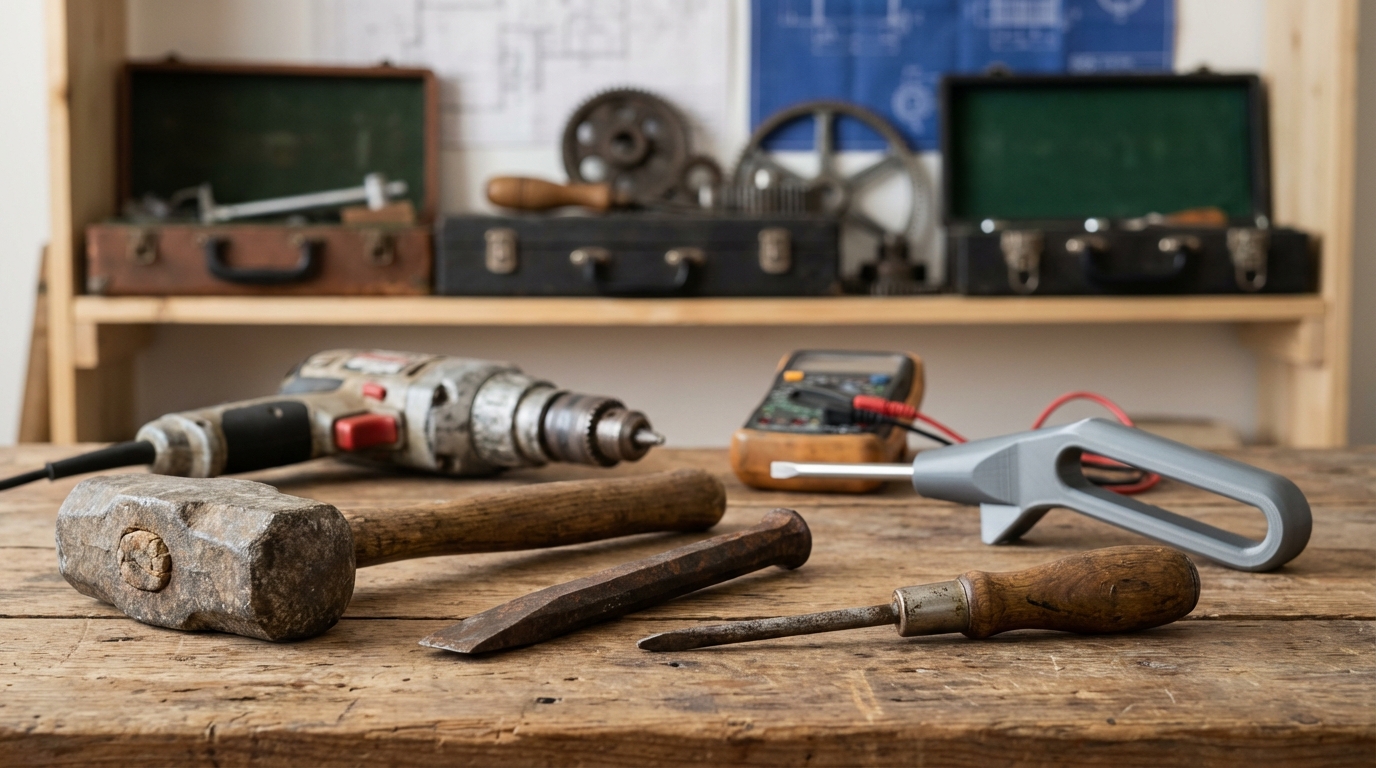
From the simplest stone flake to the most sophisticated digital interface, tools represent a fundamental extension of human capability. They are not merely objects but embodiments of ingenuity, reflecting our innate drive to shape the environment, overcome challenges, and improve our lives. The story of humanity is intrinsically linked to the evolution of its tools, each development marking a significant leap in our ability to adapt, survive, and thrive.
This exploration delves into the historical trajectory of tools, tracing their transformation from rudimentary instruments used by early hominids to the complex systems that define our modern world. We will examine how different eras and societal needs spurred innovation, leading to increasingly specialized, powerful, and efficient means of interacting with the physical and digital realms.
Early Innovations: The Dawn of Tool Use
The journey of tools began millions of years ago, with early hominids discovering and then deliberately modifying natural objects to serve specific purposes. This initial step marked a critical divergence in evolutionary paths, setting the stage for human dominance.
The Paleolithic Era and Stone Tools
The Stone Age, particularly the Paleolithic period, is defined by the extensive use of stone as the primary material for tools. These early implements were crucial for survival, enabling tasks like hunting, butchering, preparing food, and crafting shelters.
- Oldowan Technology: Around 2.6 million years ago, the earliest recognized stone tool industry emerged. Characterized by simple choppers, flakes, and scrapers, these tools were made by striking one stone (a hammerstone) against another (a core) to remove sharp-edged flakes. They were primarily used for breaking open bones for marrow and cutting meat.
- Acheulean Technology: Beginning about 1.76 million years ago, this period saw the development of more refined, bifacial tools, most notably the hand axe. These implements were shaped on both sides, demonstrating a greater understanding of symmetry and controlled flaking. Hand axes were versatile, used for chopping, digging, scraping, and piercing.
- Mousterian Technology: Associated with Neanderthals and some early modern humans, this technology, dating back roughly 300,000 years, involved the Levallois technique. This method allowed for the controlled production of flakes of predetermined size and shape, leading to a wider array of specialized tools like points, scrapers, and blades.
Beyond Stone: Wood, Bone, and Antler Tools
While stone tools survive extensively in the archaeological record, it is important to remember that early humans also utilized perishable materials. Wood, bone, and antler were vital for crafting a diverse array of implements.
- Wooden Tools: Spears, digging sticks, clubs, and rudimentary containers were fashioned from wood. Evidence for these is scarce due to decomposition, but their importance is inferred from ethnographic studies of traditional societies and rare finds.
- Bone and Antler Tools: These materials offered strength and flexibility. Awls for piercing hides, needles for sewing clothing, harpoons for fishing, and various points and barbed tools were skillfully made from bone and antler. The development of specialized bone needles, for instance, suggests the increasing complexity of clothing and shelter construction.
The Agricultural Revolution and Specialization
The transition from nomadic hunter-gatherer lifestyles to settled agricultural communities, beginning around 10,000 BCE, profoundly impacted tool development. This shift necessitated tools specifically designed for cultivation, harvesting, and processing food, leading to greater specialization and efficiency.
Tools for Cultivation and Harvesting
The demands of farming spurred innovation in implements for working the land and gathering crops.
- Hoes and Digging Sticks: Early agriculturalists used modified digging sticks and simple hoes to prepare soil for planting, break up clods, and remove weeds.
- Sickles: For harvesting grains, sickles with sharpened edges (often flint blades set into wooden or bone handles) became essential. These allowed for efficient cutting of cereal crops.
- Plows: Perhaps one of the most transformative agricultural tools, the early plow, initially drawn by humans and later by oxen, revolutionized farming by allowing for cultivation of larger areas more deeply and quickly than manual digging.
Craft Specialization and Early Metallurgy
As societies grew more complex, specialized crafts emerged, each requiring its own set of tools. The discovery and mastery of metallurgy marked a paradigm shift, introducing materials that offered superior hardness, durability, and malleability compared to stone.
- Craft Tools: Pottery production required modeling and shaping tools. Weaving involved looms and shuttles. Carpenters used adzes, chisels, and saws made from harder materials as they became available.
- Copper and Bronze Age Tools: The ability to extract and work with copper, and later to alloy it with tin to create bronze (starting around 3000 BCE), led to the production of stronger axes, chisels, knives, and weapons. Bronze tools were more resilient than stone and could be reshaped or sharpened.
- Iron Age Tools: Beginning around 1200 BCE, the widespread adoption of iron metallurgy provided an even harder and more abundant material for toolmaking. Iron tools like axes, saws, and plowshares significantly boosted agricultural productivity and enabled new forms of construction and craftsmanship.
The Rise of Mechanical Advantage: Simple Machines and Complex Devices
Over millennia, human understanding of physics and mechanics grew, leading to the deliberate application of principles to amplify force and motion. This era saw the development of simple machines that formed the foundation for increasingly complex devices.
Principles of Levers, Pulleys, and Wheels
The conceptualization and application of basic mechanical principles fundamentally extended human capabilities beyond mere muscle power.
- Levers: Used since prehistoric times, levers amplify force, allowing heavy objects to be lifted or moved with less effort. Examples range from simple crowbars to complex trebuchets.
- Pulleys: Ancient Egyptians used pulleys in construction, and later civilizations refined them. Pulleys reduce the force needed to lift loads or change the direction of force, making hoisting tasks more manageable.
- Wheels: The invention of the wheel (around 3500 BCE) revolutionized transport and pottery, but its application in gears, water wheels, and windmills further demonstrated its power to transmit and modify motion, crucial for early industrial processes.
The Industrial Revolution and Mass Production
Beginning in the late 18th century, the Industrial Revolution transformed toolmaking and manufacturing. New power sources, particularly steam, enabled the creation of sophisticated machinery that could produce goods on an unprecedented scale.
- Machine Tools: Precision tools for cutting, shaping, and forming metal became central. Lathes, milling machines, drill presses, and grinders, initially powered by water and later by steam, allowed for the mass production of standardized components, facilitating assembly-line production.
- Specialized Factory Tools: Tools like power looms for textiles, mechanical presses for metalworking, and advanced printing presses dramatically increased efficiency and output across various industries. The focus shifted from handcrafted tools to machine-made tools capable of complex, repetitive tasks.
The Information Age: Tools of Precision and Connectivity
The 20th and 21st centuries have ushered in an era where tools are increasingly defined by electronics, digital technology, and automation. This shift has not only amplified our physical capabilities but also revolutionized our ability to process information, communicate, and create on a virtual plane.
Electrical and Electronic Tools
The harnessing of electricity led to a new generation of tools that extended beyond purely mechanical functions.
- Power Tools: Electric drills, saws, sanders, and grinders replaced manual counterparts, offering greater speed, power, and efficiency in construction, woodworking, and manufacturing.
- Measurement and Diagnostic Tools: Oscilloscopes, multimeters, and various sensors became essential for understanding, analyzing, and troubleshooting electrical and electronic systems.
- Communication Devices: From the telegraph and telephone to radio and television, electronic tools have dramatically transformed how humans connect and share information across vast distances.
Digital Tools and Automation
The advent of computers marked a profound shift, enabling tools that could process information, execute complex instructions, and perform tasks with unprecedented precision and autonomy.
- Computer-Aided Design (CAD) and Manufacturing (CAM): Software tools allow engineers and designers to create virtual models, simulate performance, and then directly control machinery for manufacturing, leading to highly complex and precise parts.
- Robotics: Robotic arms and automated systems are now integral to manufacturing, performing repetitive, dangerous, or highly precise tasks with consistency and speed, from assembling electronics to performing surgery.
- Software Tools: Beyond physical interaction, software itself has become a tool. Word processors, spreadsheets, programming languages, and design software empower individuals to manipulate information, create content, and solve problems in entirely new ways.
Advanced Materials and Manufacturing
The development of new materials and manufacturing techniques has necessitated and been enabled by new categories of tools.
- Additive Manufacturing (3D Printing): This revolutionary process builds objects layer by layer from digital designs, allowing for the creation of intricate geometries and custom parts from various materials, including plastics, metals, and ceramics.
- Nanotechnology Tools: Tools operating at the nanoscale, such as atomic force microscopes and scanning tunneling microscopes, allow for imaging, manipulation, and even construction of materials at the atomic and molecular level, opening doors to entirely new classes of materials and devices.
- Tools for Composites and Polymers: Specialized cutting, shaping, and bonding tools are required to work with advanced composite materials and engineered polymers, which are increasingly used in aerospace, automotive, and consumer goods industries.
Conclusion
The evolution of tools is a compelling narrative of human innovation, adaptation, and progress. From the rudimentary stone choppers that first extended our physical reach to the sophisticated digital systems that amplify our intellect, tools have consistently been at the forefront of our development. Each era has brought forth new challenges and, in turn, new tools to overcome them, fundamentally reshaping our societies, economies, and understanding of the world.
The journey of tools is far from over. As we continue to push the boundaries of materials science, artificial intelligence, and interconnectivity, the tools of tomorrow will undoubtedly appear as transformative to us as the simple hand axe was to our ancestors, continuing humanity’s endless quest to build, explore, and create.
FAQs
Q1: What is considered the earliest tool?
A1: The earliest widely accepted tools are Oldowan stone tools, dating back approximately 2.6 million years. These were simple choppers and flakes made by striking one stone against another to create a sharp edge.
Q2: How did the discovery of metallurgy impact tool development?
A2: Metallurgy, particularly the working of copper, bronze, and iron, revolutionized tool development by providing materials that were harder, more durable, and more easily shaped than stone. This allowed for the creation of more effective cutting implements, agricultural tools, and specialized craft instruments.
Q3: What characterized tools during the Industrial Revolution?
A3: Tools during the Industrial Revolution were characterized by mechanization and mass production. They were often powered by steam or water, focused on precision engineering, and designed to create standardized parts, leading to factory systems and assembly lines.
Q4: How do digital tools differ from traditional mechanical tools?
A4: Digital tools primarily operate by processing information and executing programmed instructions, often extending our cognitive and communicative abilities. Traditional mechanical tools, by contrast, physically extend our strength and dexterity to manipulate matter directly.
Q5: What role do tools play in human evolution?
A5: Tools have played a critical role in human evolution by enabling early hominids to access new food sources, protect themselves, and adapt to diverse environments. This, in turn, fostered brain development, social cooperation, and the development of complex problem-solving skills, fundamentally shaping human history.

Diana Miller, is a dedicated nature enthusiast and an outdoor adventurer. She began leading groups for excursions in her teens and never stopped. Following her passion for nature, she gathers her friends for outdoor trips every now and then. And for the last 10 years, she has executed workshops on backpacking, snow kayaking and traveling that included her main motive of lightweight packing while outdoors. During leisure, she loves planning for her next adventure.